Is it AI or is it a C-Suite Grab Back?
I’ve been watching a pattern lately with founders, with companies that have grown, and with some of the larger hosting companies. They’re getting rid of people who, on the surface, look like leaders.
A hosting company a few months ago got rid of its whole customer success team, ten or twelve people, overnight. It was a decision that happened, everybody had to live with it, then a few more people went, and now a few more have gone from even more hosting companies. It seems that every time it’s mostly framed as AI.
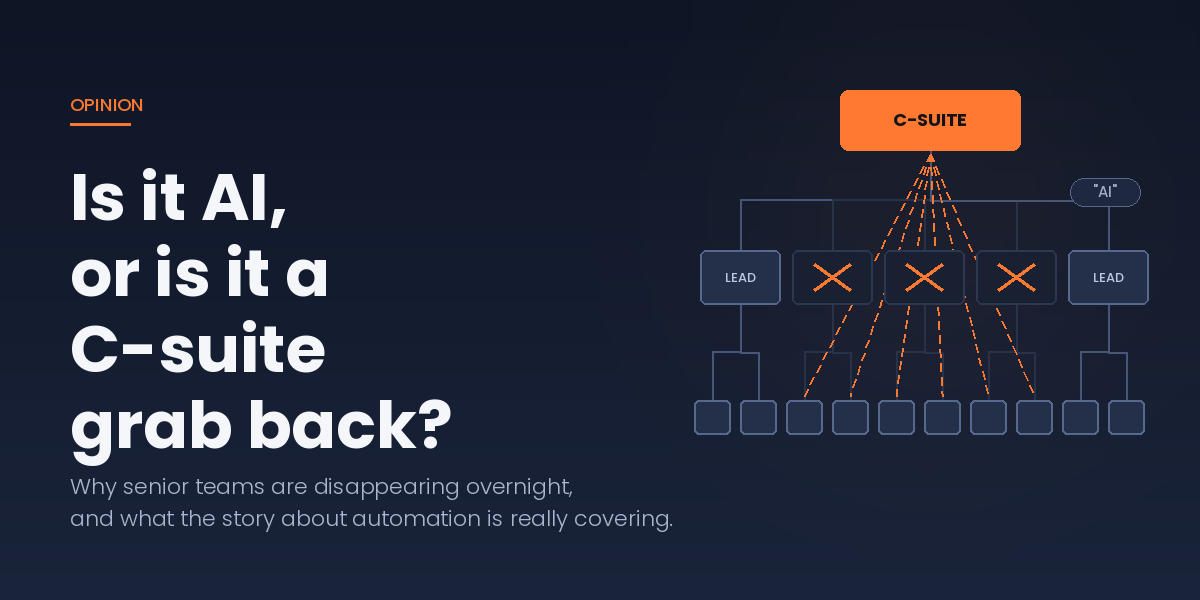
I don’t think it’s just AI. I think it’s a C-suite grab back.
Here’s what I mean. Over the last few years these companies gave away a lot of authority in order to grow. When you’re scaling fast the CEO can’t be in every decision, so power gets pushed down. The head of customer success owns retention, the VP of engineering owns the roadmap, the ops lead owns hiring and process. Those people become powerful in their own right. They have their own teams, their own budgets, their own relationships with the big customers, and after five or six years they have their own firm opinions about how the company should be run. At that point the C-suite is partly running the business and partly negotiating with its own senior staff.
The problem with technology is that it moves fast. If you’re five, six, ten years into the business and you’ve done things a certain way, that way starts to not fit anymore.
I’ve had this in restaurants. Chefs, waiters, managers, all doing things the way they’ve always done them, and it simply stops working for where the business needs to go. That’s what I think is happening in these companies. It’s a “let’s get a bit modern” moment. Yes, you’ve done a fantastic job growing the business, but three, five, ten years in you’ve become a bit of a roadblock. Your ideas aren’t as fresh as they were. Your methods and attitudes aren’t what we want from a company that’s trying to get from 2026 to 2050. You’re not grabbing hold of AI, you’re not grabbing hold of innovation, and you’re very highly paid.
So when growth slows or costs bite, leadership looks at that layer and sees a problem.
Every change of direction means persuading people who built the current way of doing things and who, understandably, defend it. The grab back is exactly that: pulling decision-making authority back to the top, flattening the structure, and removing the people whose seniority gave them the standing to say no. AI is a convenient story because it lets you say “we’re becoming leaner and more automated” instead of “we want fewer people with the power to slow us down.” It also plays well with boards and investors. It sounds forward-looking rather than defensive.
The customer success team is a good example precisely because it has an independent power base. It talks to customers directly, it knows what they think, and it can go to the CEO and say “this product decision will lose us these accounts.” Getting rid of it wholesale doesn’t just save salaries. It removes a voice.
And it’s worth noting that no AI system gets stood up in a day to handle a hosting company’s renewals and churn risk.
That was a cost and control decision somebody had wanted to make for a while, and AI gave them a respectable reason to make it now. Add to that the fact that a lot of these companies overhired in 2021 and 2022, and you can see why senior headcount is where the knife goes. That’s where the money is.
I’ll be fair about it, though. This isn’t always cynical.
Sometimes the entrenched layer really has become the roadblock and the only way to change the culture is to change the people. Founders and early leaders can get very good at protecting how things were done. But those same people also know why things are done a certain way, who the important customers are, and where the bodies are buried.
Companies that clear them out to “get modern” often find six months later that the new hires are relearning lessons the old team already knew, and that customers who liked dealing with a familiar face have quietly moved on. The restaurant lesson cuts both ways. Replacing a set-in-his-ways chef can be liberating, or it can be the moment your regulars notice the food isn’t the same.
So the question isn’t really “is it AI or is it a grab back,” because it’s both in different proportions. The sharper question is whether the leadership doing the cutting has a plan for what replaces those people, or whether “we’re embracing AI” is doing all the work.
When it’s done overnight, with no transition and no thought for who picks up the relationships, that tells you the priority was control and cost, not capability. Real modernisation is slower and messier than that, because you need the old knowledge long enough to hand it over, so you can move faster towards what success looks like now.