The Vision: The Agentic “One-Click” Infrastructure
The web hosting industry has spent two decades adding features, but it has completely forgotten about flow.
We are marketed the promise of “seamless integration,” yet the reality of launching a secure, well-configured website in tis age of AI, remains a fragmented, multi-step chore.
If we are going to push Agentic solutions – It is high time for a paradigm shift from manual configuration to true agentic automation. Here is, in my opinion as both a user of hosting and having offered hosting it as an agency partner (manly because users were flummoxed at the first steps) is what the future of web hosting and domain registration should look like and why the current model is no longer acceptable.
Imagine a hosting company and domain registrar that doesn’t just sell you a domain or server space, but actively works for you as an intelligent agent. The ideal solution removes the friction of infrastructure entirely.
Here is what that looks like:
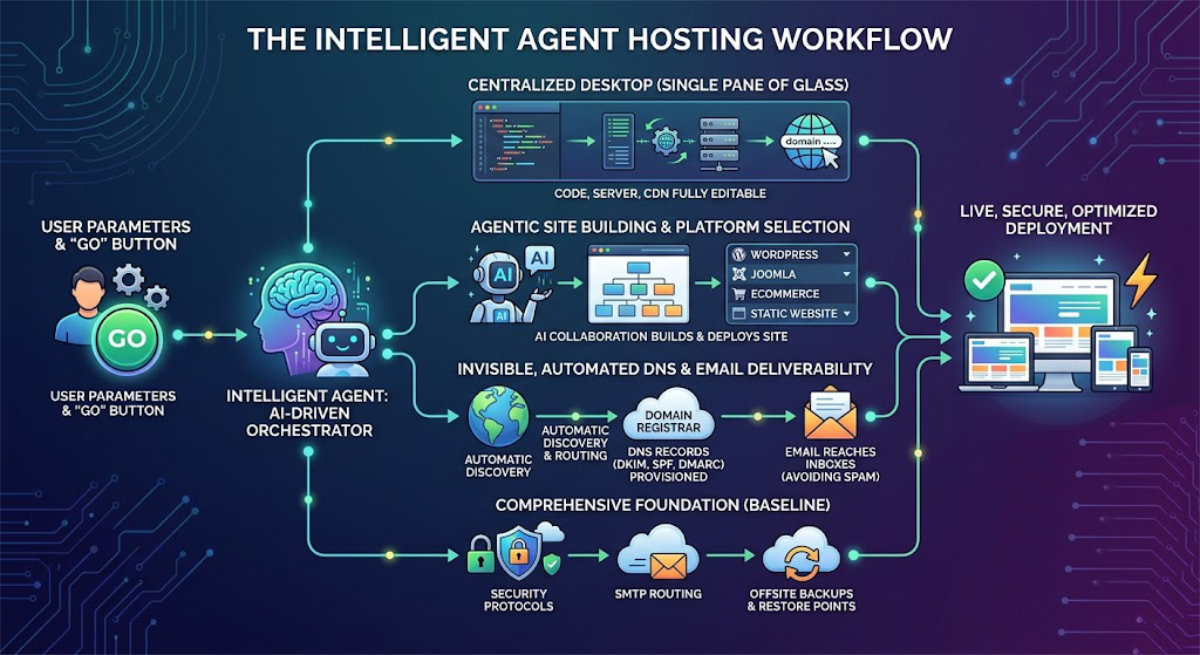
- A True Centralized Desktop: A single pane of glass where everything from the code to the server architecture is fully editable and accessible. No jumping between cPanel, a registrar dashboard, and a separate CDN portal.
- Agentic Site Building: You don’t just pick a template; you collaborate with an AI agent that builds and deploys your site architecture based on your specific requirements. I also want to be able to choose my platform, be it WordPress, Joomla, ecommerce or just a simple static website.
- Invisible, Automated DNS & Email Deliverability: This is the holy grail. The moment you connect a domain, the agent automatically discovers where the domain is registered and handles the technical routing. It instantly provisions and deploys all required DNS records, including DKIM, SPF, and DMARC, ensuring your emails actually reach inboxes instead of spam folders.
- Comprehensive Foundation: Security protocols, SMTP routing, offsite backups, and automated restore points aren’t premium add-ons you have to manually configure. They are the baseline.
- The “Go” Button: You define your parameters, and all of the above happens concurrently the second you click a single button.
To visualize the difference in efficiency, compare the traditional fragmented setup against an agentic workflow:
The Reality: How We Launch Sites Today
Contrast that vision with the reality of what happens now with the vast majority of hosting companies. Today, launching a site is an exercise in managing a Frankenstein’s monster of disjointed services.
- The Registrar Disconnect: You buy a domain at Registrar A. You buy hosting at Company B. You now have to log into Registrar A, find the custom nameservers for Company B, update them, and wait for propagation. The registrar offers no active help in setting up your hosting environment.
- The DNS and Email Scavenger Hunt: Your hosting company might give you an SSL certificate, but if you want to send emails reliably, you are on your own. You have to manually generate SPF and DKIM text records, log back into your DNS zone editor, and paste them in. Setting up DMARC requires reading third-party documentation and hoping you formatted the string correctly.
- The SMTP Workaround: Because native server PHP mail is notoriously unreliable and easily spoofed, you have to go sign up for a third-party transactional email service (like Brevo or many others), generate API keys, and install a plugin or configure your server to route mail through it.
- The Backup Illusion: Many hosts offer “daily backups,” but they are stored on the same server network as your site. True offsite backups require setting up a separate server, Amazon S3 bucket, Dropbox, or Google Drive integration, creating API credentials, and scheduling CRON jobs.
Why “Almost” Isn’t Good Enough
We are at a point in technological capability where offering just one or a few of these features is no longer a competitive advantage. It is a dealbreaker.
If a host offers automated backups but forces the user to manually configure their DMARC and DKIM records to ensure their contact forms actually deliver messages, the host has failed. If a registrar sells a domain but leaves the user to navigate the labyrinth of SMTP configuration, find a host and or email provider alone, they are providing a commodity, not a service.
Providers need to understand that users don’t want to buy “hosting” or “domains.” They want to buy a live, secure, functioning digital presence. Until a company can provide that entire stack autonomously behind a single “Go” button, they are just selling puzzle pieces and asking the user to figure out how they fit together.